



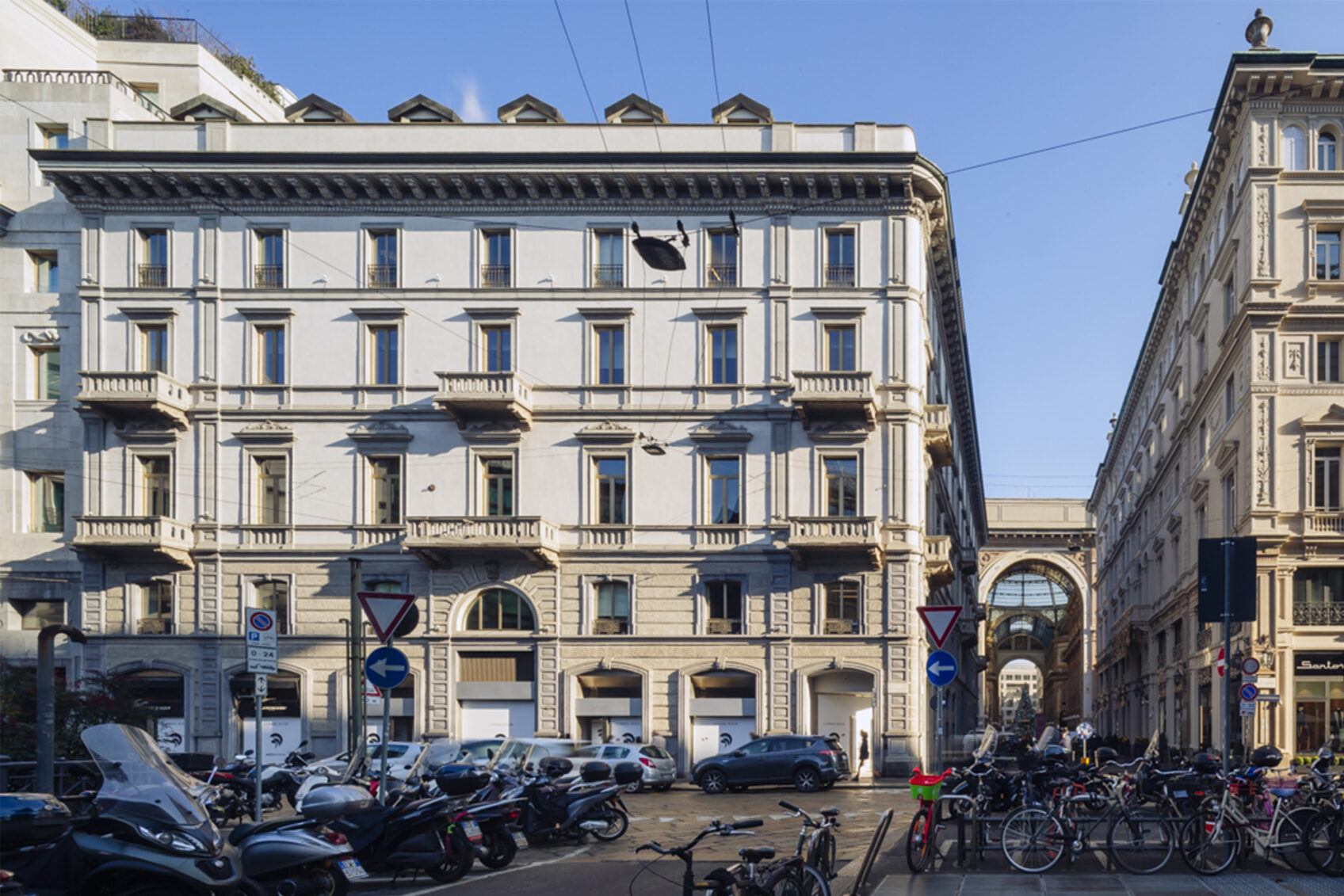
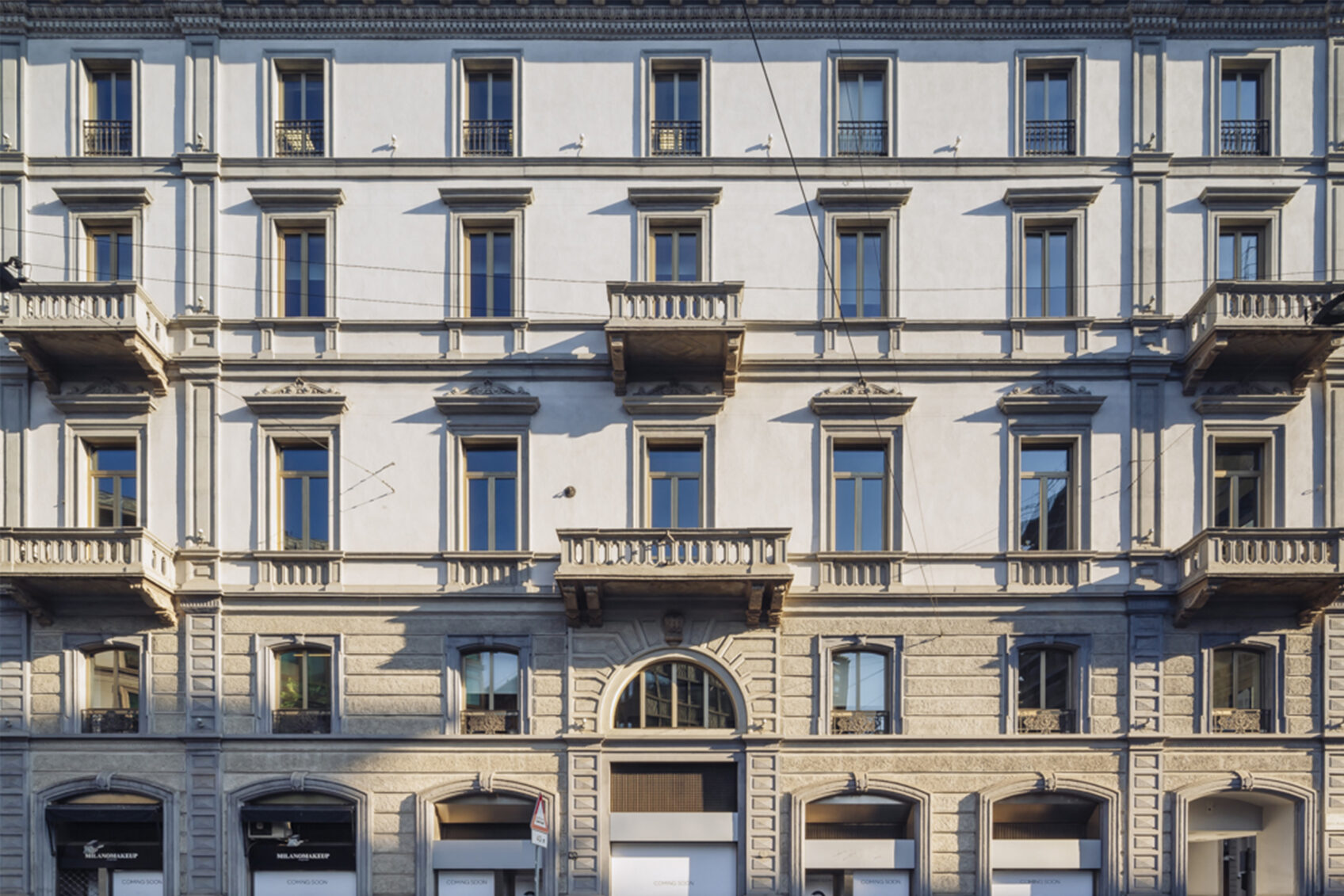
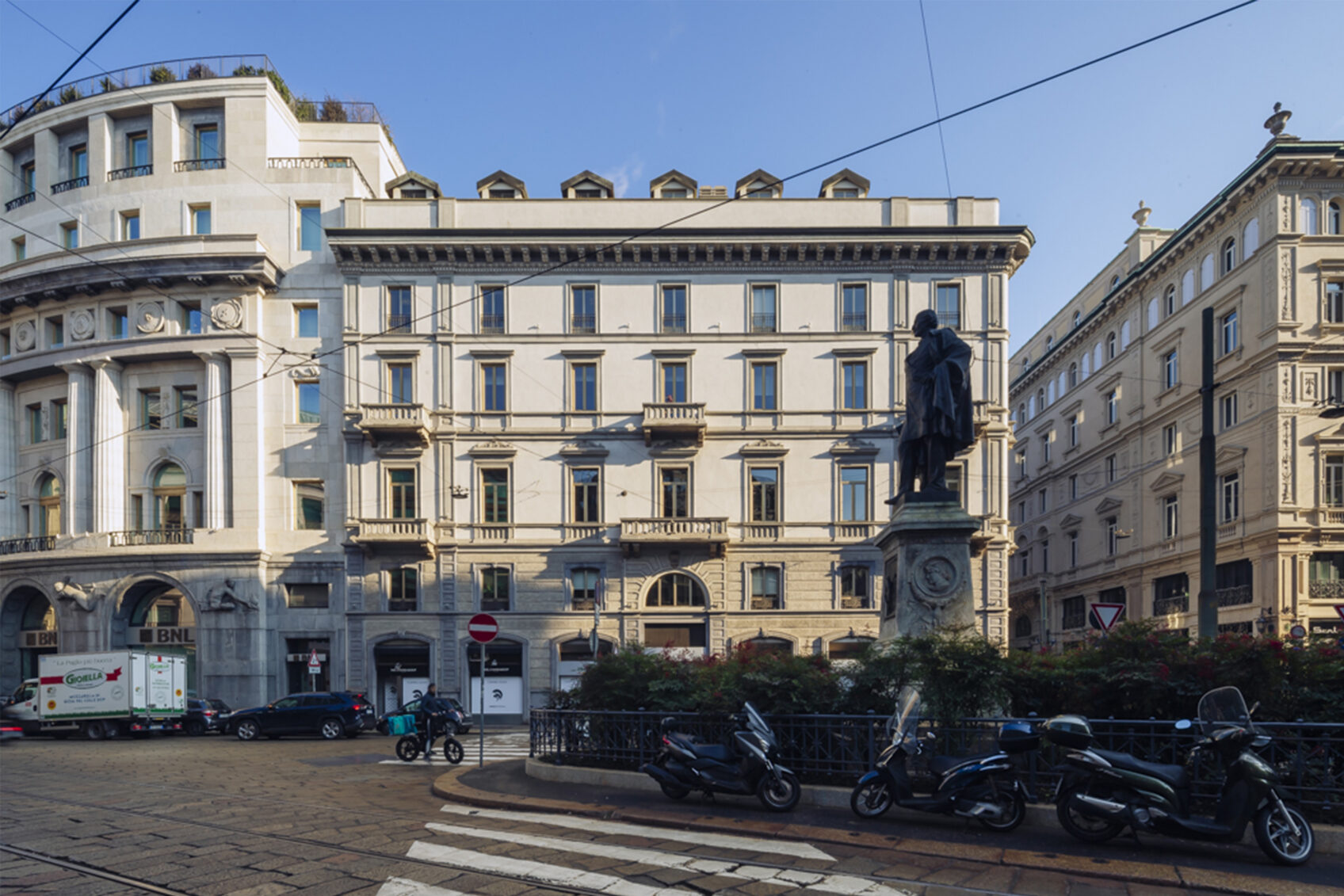
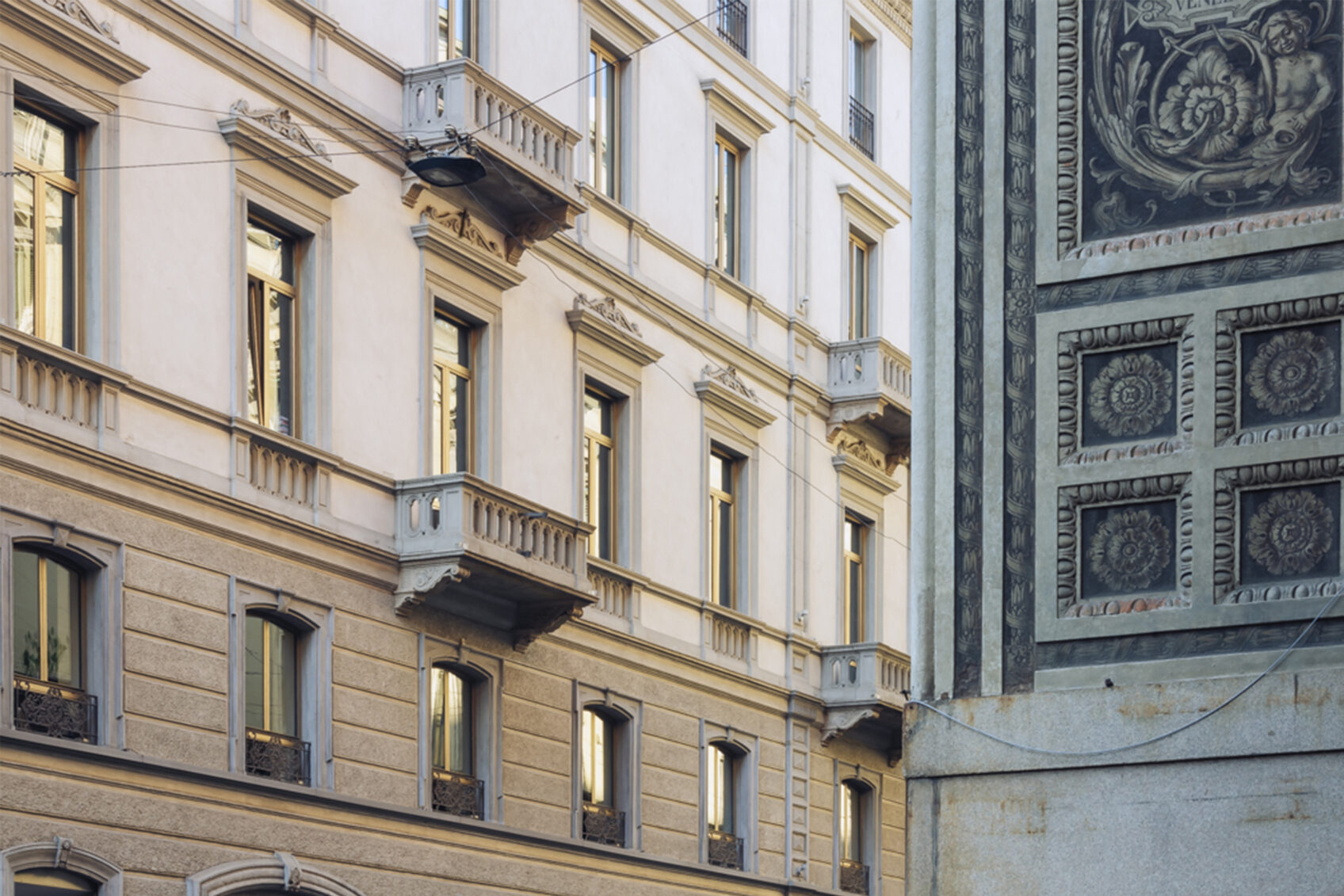
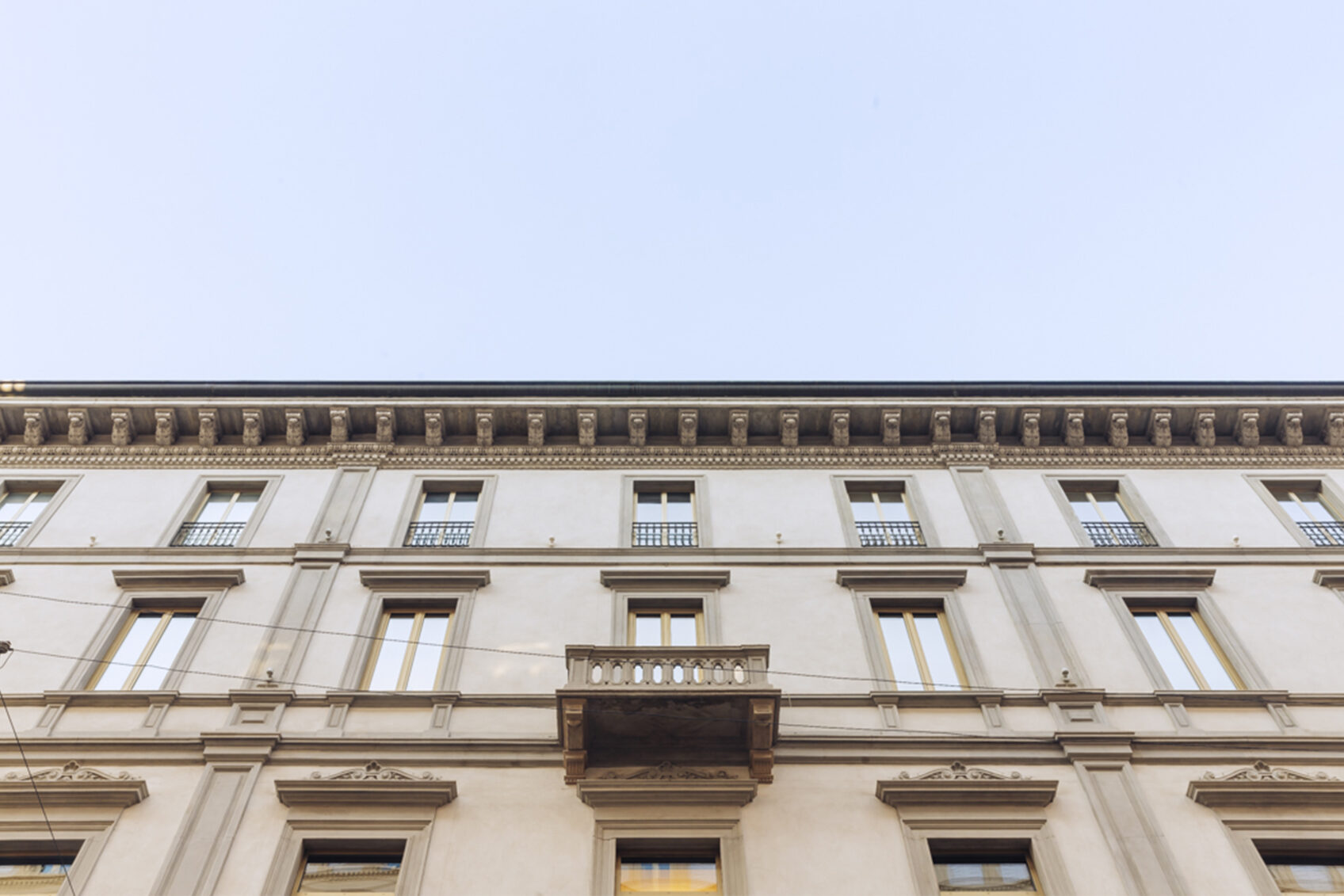
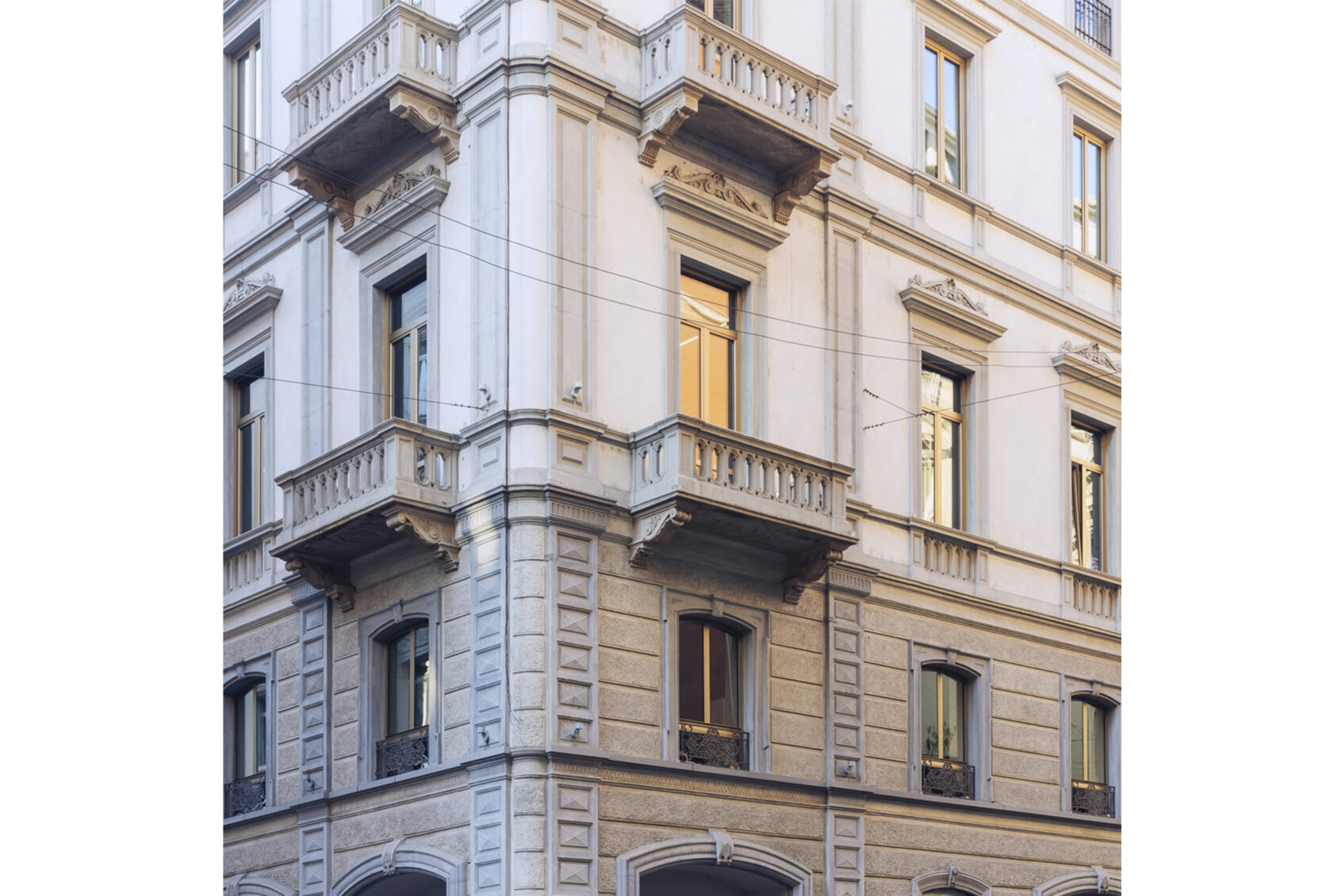
Palazzo Ricordi is a neo-Renaissance building located near the east side entrance to Galleria Vittorio Emanuele II in the center of Milan. Built in 1880, it became the headquarters of the Ricordi publishing house in 1920, from which it still takes its name. The redevelopment involved its architectural, plant engineering and technological restoration, with the provision of commercial spaces on the ground floor, offices on the upper five floors and storage and technical rooms in the basement. The project, which involved a total area of 5,000 square meters, was articulated in relation to the degraded state of the courtyard, the functional, distributional and technological deficiencies of the structure, and the historical aspects of the building.
At street level, the entrance that provides access to the upper floors was relocated to Via Berchet, bringing it closer to the existing stairwell, which was already equipped with elevators: a modification that involved adapting the facade to the new central perspective. From the point of view of vertical distribution, in order to rationalize the paths, all small staircases were demolished, in exchange for keeping the main one and building a new one, equipped with an elevator. The internal courtyard was also upgraded, completing the building's internal volumes and redesigning the forometries of the windowed parts, so as to align them with each other and favor their compositional appearance.
The intervention also included a series of improvements in an earthquake-resistant function. A lightened structural concrete slab, integral with the original structures, was applied to the floors, increasing their flexural strength, while a new steel floor slab was laid on the first three floors abutting the existing neighboring building to the north. The four new stairwells and three new elevator shafts were made of concrete, with 250-mm-thick walls resting on a 500-mm-thick slab and a 150-mm slab at the top.
The entire intervention was characterized by a sustainability-oriented approach, thanks to the inclusion of plant and technological systems functional to a logic of energy and water saving, reduction of CO2 emissions and improvement of the ecological quality of the interior. These measures, combined with the choice of materials and resources, the building's connection to the public transport network and the inclusion of services related to green mobility such as bike sharing, made it possible to obtain LEED - Gold (Core & Shell) certification.
info@buromilan.com
stampa@buromilan.com
C.F./P.I. 08122220968
C.D. M5UXCR1
Spotorno Square, 3
20159 Milan - Italy
T +39 02 36798890
Santa Croce 458/A
30135 Venice - Italy
T +39 041 5200158