



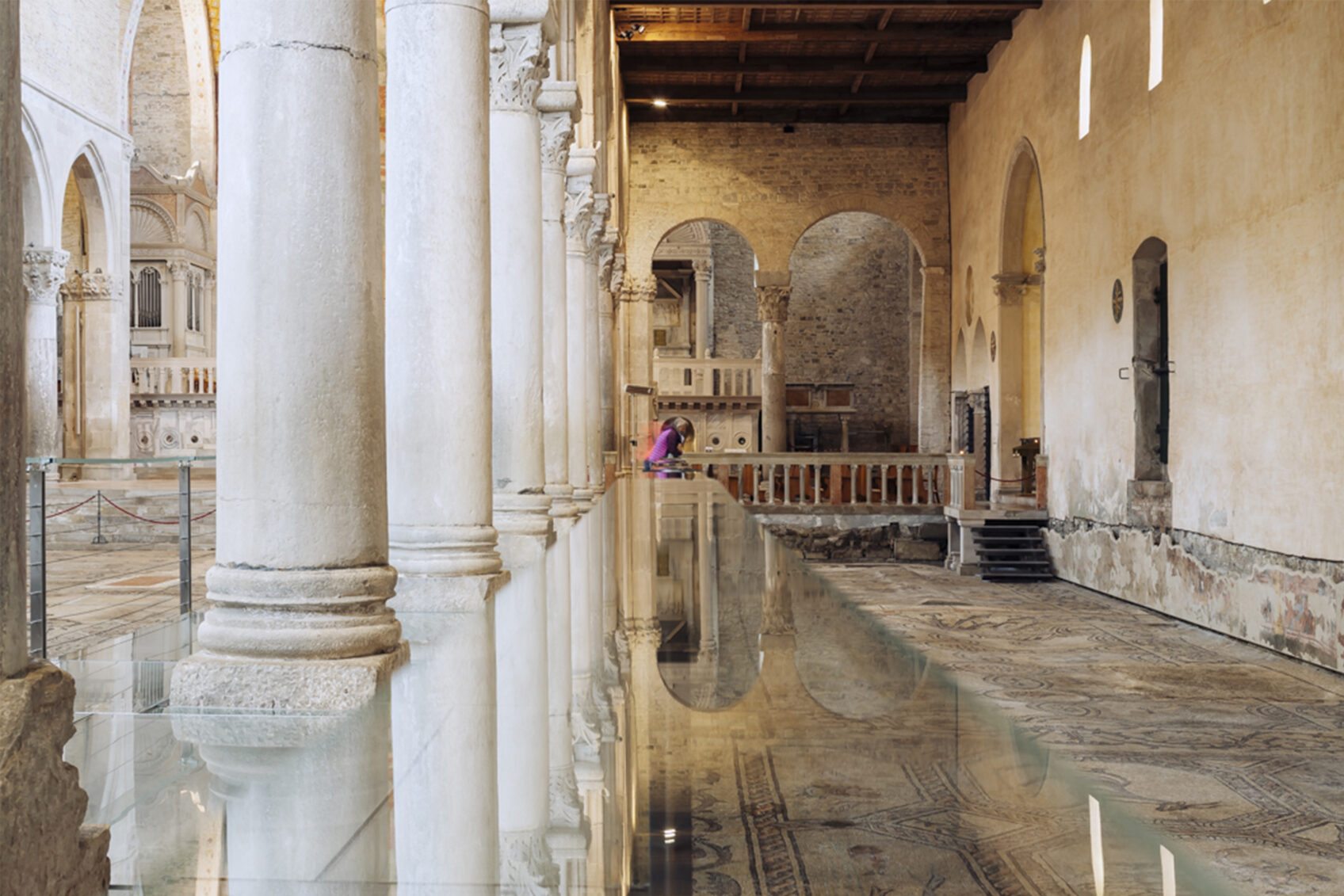


The history of the basilica of Aquileia begins in the aftermath of the Edict of Milan, by which in 313 A.D. Emperor Constantine ended the persecution of Christians. The first nucleus of the religious building was then born, which, between the fourth and fourteenth centuries, was rebuilt in several stages, superimposing new constructions on the remains of the previous ones from time to time. The polychrome mosaic that makes up the currently visible floor dates from the fourth century and was brought to light in the early twentieth century, when, following its discovery, the medieval red-and-white tiled floor that covered it was removed.
At 760 m², the work constitutes the largest early Christian mosaic in the Western world, as well as one of the best preserved, while the entire archaeological area is now a UNESCO-recognized World Heritage Site. However, the constant stress due to the passage of visitors made it necessary to prepare a solution that would safeguard the integrity of the mosaic, without limiting its usability to the public. It was in this context that the glass path system was born: a walkway suspended one meter from the decorated floor, so that it would be at the same height as the previous medieval floor


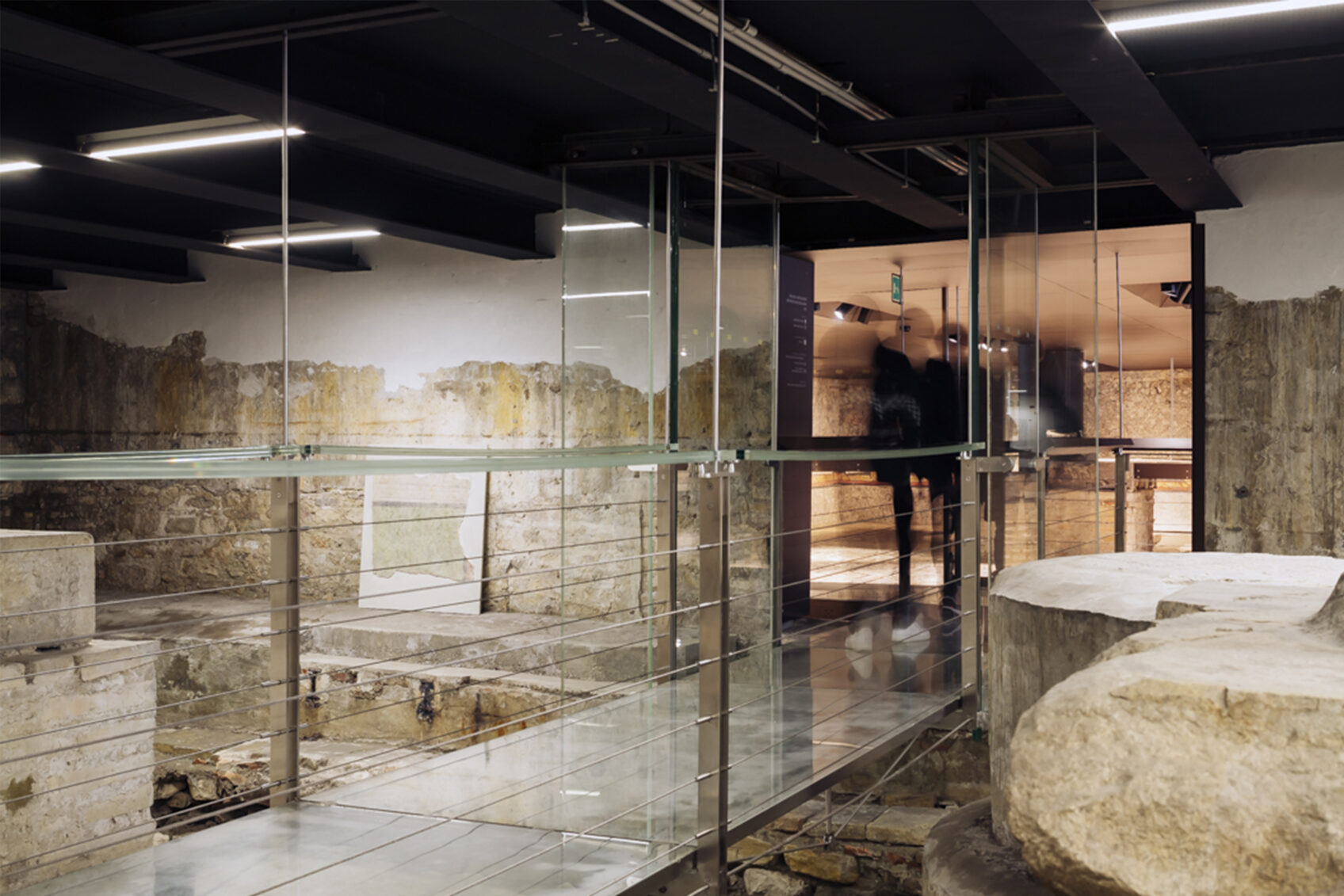
All structures are designed so that they can be removed completely, leaving no trace behind. Overall, the route consists of two parts, characterized by different technical requirements. The first part, which runs longitudinally through the Basilica, features a stainless steel structure anchored directly to the column bases. In the second part, which runs through the adjacent hall, the frame structure is instead suspended from the new ceiling slab.
Resting on the steel structure, which forms the framework of the pathway, are 12 mm thick sheets of structural, tempered and laminated glass. Added to this load-bearing stratigraphy is an additional sacrificial sheet, made of chemically tempered glass, only 3 mm thick, designed to be replaced every two years. The glass used of extra-clear quality ensures remarkable transparency and a load resistance of 5 kN/sqm.
info@buromilan.com
stampa@buromilan.com
C.F./P.I. 08122220968
C.D. M5UXCR1
Spotorno Square, 3
20159 Milan - Italy
T +39 02 36798890
Santa Croce 458/A
30135 Venice - Italy
T +39 041 5200158